














Key Takeaways
- Integrated barcode, RFID, and inventory software provide businesses with real-time updates and greater accuracy, improving operational efficiency and reducing manual processes.
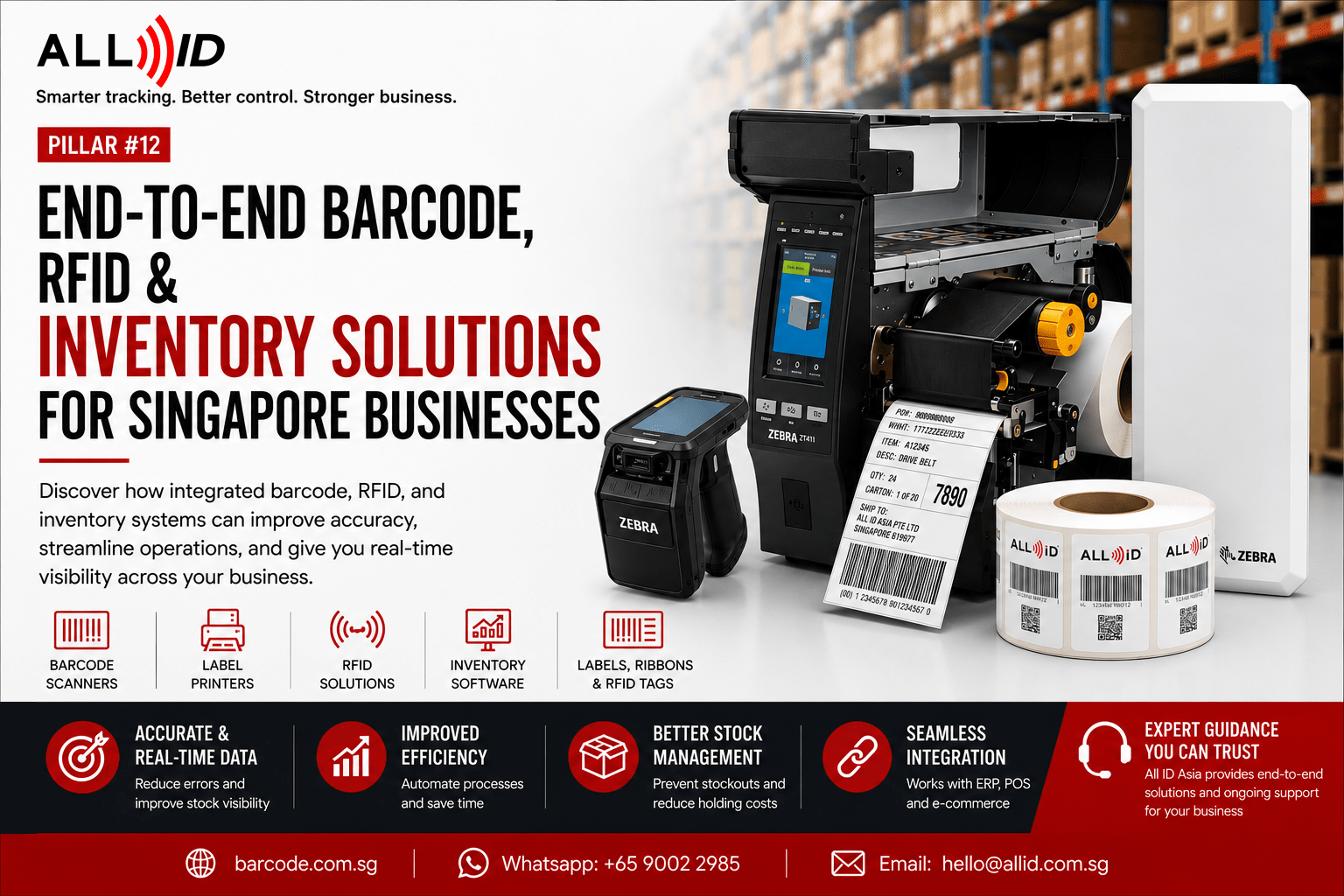
- All ID Asia (Barcode.com.sg) offers barcode scanners, RFID readers, label printers, barcode labels, and inventory management software as part of complete end-to-end solutions with seamless integration.
- Barcode and RFID solutions in Singapore serve different business needs, with many organisations benefiting from a hybrid approach that enhances stock management across locations.
- Integrated systems improve inventory tracking, asset management, stock control, and reporting across warehouses, retail, manufacturing, and logistics.
- Explore our inventory software and hardware pages to learn more about each component and how they support your growing business.
Introduction: Why Singapore Businesses Need Smarter Inventory Tracking
As Singapore’s business landscape evolves, managing inventory manually becomes increasingly risky and inefficient. Traditional manual processes like spreadsheets, paper records, and disconnected systems often result in errors, delays, and risky stockouts.
Integrated barcode and RFID inventory solutions in Singapore automate inventory tracking, reduce manual errors, and improve resource allocation and operational speed.
Rather than relying on standalone hardware, modern barcode inventory management solutions combine barcode scanners, RFID technology, label printing, and inventory software into a connected ecosystem. This enables businesses to track stock movements across multiple locations, prevent stockouts, and make better operational decisions using accurate, real-time data.
Small businesses in particular benefit from this shift, as barcode-enabled inventory software removes manual stock counting and gives even lean teams real-time visibility over what they hold and where.
What Is an End-to-End Barcode, RFID & Inventory Solution?
An end-to-end barcode, RFID and inventory solution brings together barcode scanners, label printers, RFID technology and inventory management software into one connected system. It helps businesses manage inventory from receiving and storage to picking, shipping and reporting. By keeping inventory data up to date in real time, businesses gain better visibility, improve accuracy and make day-to-day operations more efficient.
For businesses, this means consistent inventory data across warehouses, retail outlets, offices, and e-commerce platforms, giving teams greater visibility, control, and the ability to respond quickly as the business grows.
What Components Make Up the System?
A complete barcode solution for Singapore businesses includes several essential components designed for seamless integration.
Barcode scanners
Barcode scanners capture item information quickly and accurately during receiving, put-away, picking, stock transfers, and stock counts. They are the primary data-entry point of the system — every scan feeds directly into your inventory records, replacing manual keying and the errors that come with it.
Label printers
Label printers produce clear, durable barcode labels for products, pallets, shelves, and assets. Without reliable labels, even the best scanners and software fail — so print quality and label durability are foundational to the whole system, especially in Singapore’s humid climate.
RFID devices
RFID readers and tags enable automated data capture without direct line-of-sight scanning. Fixed readers, handheld devices, and specialised RFID tags support faster inventory tracking and asset management, especially in high-volume or multi-warehouse environments. RFID tags hold more data and offer enhanced durability and security compared to traditional barcodes. Explore our RFID readers and tags to see which devices suit your environment.
Inventory software
Inventory software acts as the central platform managing stock records, serial numbers, batch information, reorder alerts, reporting, and user access while connecting barcode and RFID workflows. Integration with ERP and POS systems ensures real-time updates and seamless data flow. Solutions like the Pesona Inventory Management System (IMS Basic) centralise stock data across locations while connecting directly with barcode and RFID hardware for on-the-go stock management.
Labels, ribbons, and RFID tags
High-quality consumables like barcode labels, ribbons, and RFID tags are crucial for reliable system performance. Select consumables based on your operating environment — Singapore’s humidity, heat, and frequent handling all affect long-term scanning reliability.
How These Components Work Together
An integrated barcode inventory management solution creates a smooth workflow across the entire inventory lifecycle.
Create labels
Barcode labels or RFID tags are generated using product information such as SKUs, serial numbers, batch numbers, expiry dates, or QR codes, then printed or encoded for application.
Scan items
As products move through receiving, storage, picking, packing, or shipping, barcode scanners or RFID readers capture each transaction, reducing waiting times and manual processes.
Real-time inventory updates (track movement)
Each scan instantly updates the inventory management system, providing accurate stock levels, preventing stockouts, and reducing discrepancies caused by manual data entry.
Sync stock data
Managers access dashboards showing inventory availability, stock movement, slow-moving items, and exception reports that support better planning, stock management, and purchasing decisions.
System integration for improved visibility and reporting
Many organisations integrate inventory software with ERP, POS, or e-commerce platforms, ensuring inventory data remains synchronised across warehouses and sales channels for smooth day-to-day operations.
Business Benefits of an Integrated Solution
Implementing end-to-end barcode solutions delivers measurable operational improvements beyond faster scanning.
Better inventory (stock) accuracy
Automated data capture improves stock accuracy by reducing manual entry errors and manual processes, resulting in more reliable inventory records and fewer discrepancies. Businesses that move from manual tracking to automated capture routinely see inventory accuracy climb into the high nineties, significantly reducing costly stock discrepancies.
Faster operations
Barcode scanning accelerates receiving, stock counts, and order fulfilment, while RFID enables rapid bulk scanning for even greater speed and efficiency on the warehouse floor. Barcode scanning dramatically shortens stock counts, while RFID’s bulk-reading capability can compress stock-taking that once took hours or days into a fraction of the time.
Improved traceability
Serial number, batch, asset, and QR code tracking provide complete visibility throughout the supply chain, supporting recalls, warranty management, and regulatory compliance.
Better decision-making
Accurate, real-time inventory data allows businesses to optimize purchasing, manage stock levels more effectively, and improve warehouse operations planning.
Higher workforce productivity
Reducing repetitive manual tasks frees employees to focus on higher-value activities, enhancing overall operational performance and resource utilisation.
Which Businesses Need End-to-End Barcode & Inventory Solutions?
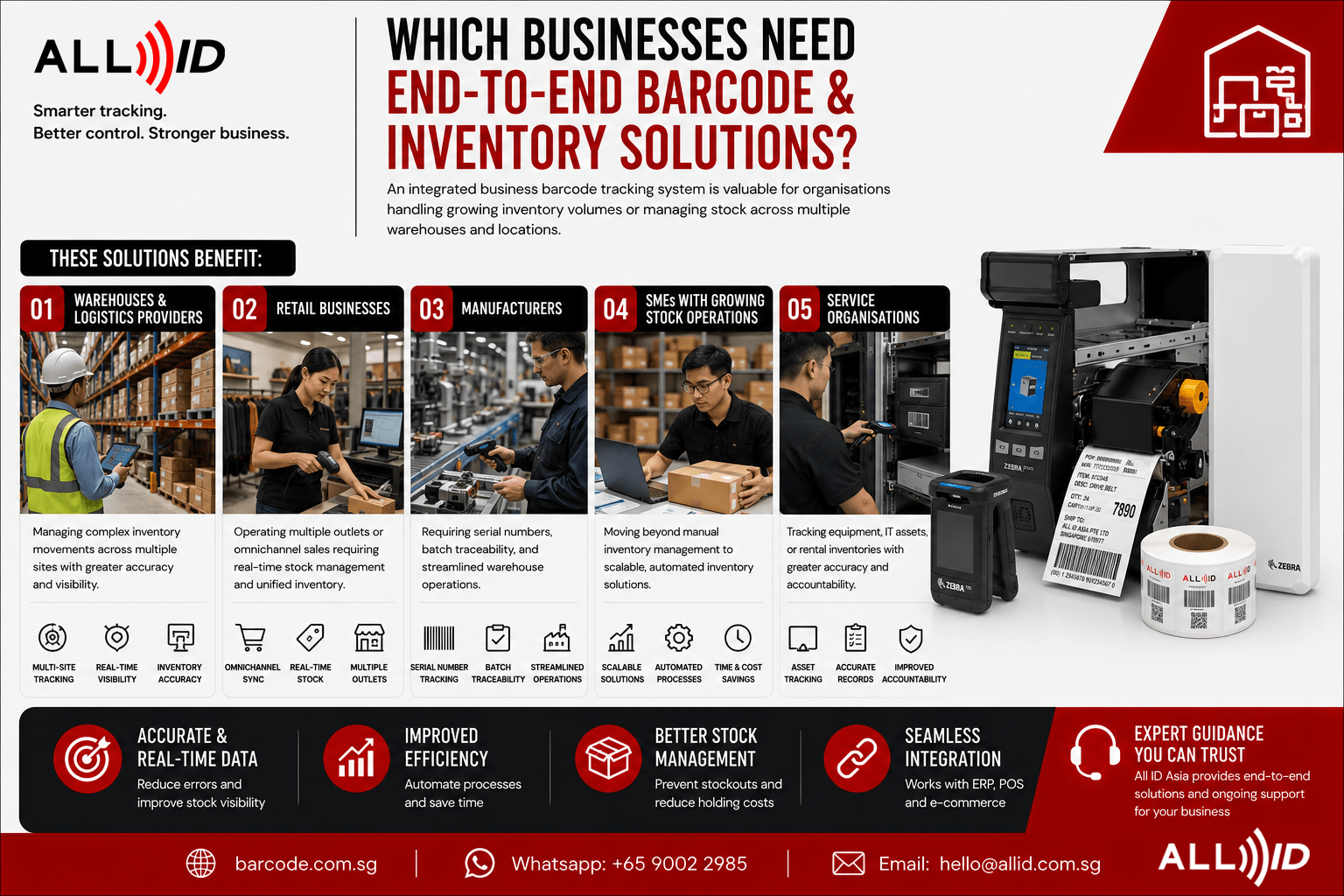
An integrated business barcode tracking system is valuable for organisations handling growing inventory volumes or managing stock across multiple warehouses and locations.
These solutions benefit:
- Warehouses and logistics providers managing complex inventory movements across multiple sites.
- Retail businesses operating multiple outlets or omnichannel sales requiring real-time stock management.
- Manufacturers requiring serial numbers, batch traceability, and streamlined warehouse operations.
- SMEs with growing stock operations moving beyond manual inventory management to scalable, automated solutions.
- Service organisations tracking equipment, IT assets, or rental inventories with greater accuracy.
Barcode vs RFID: When Should You Use Each?
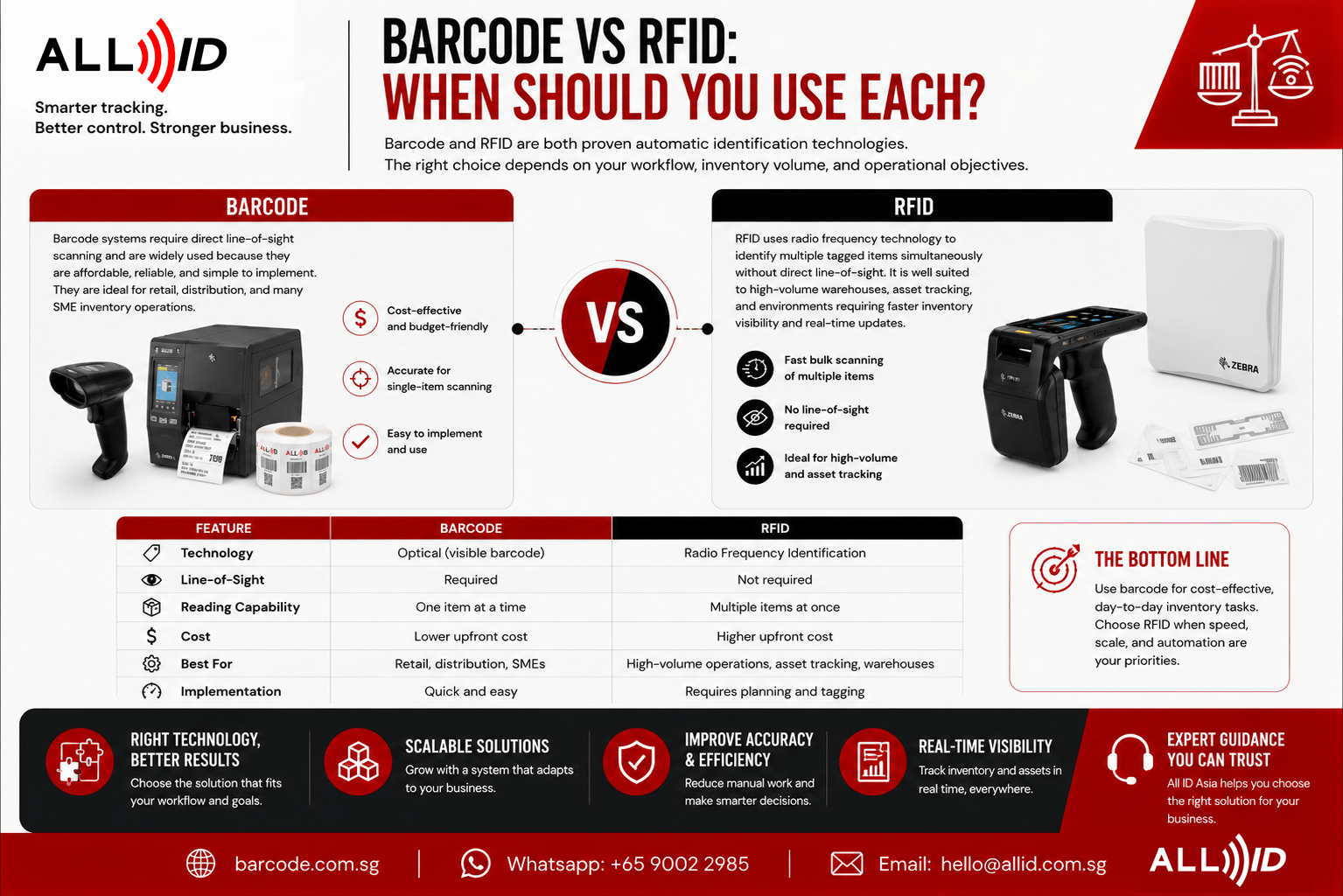
Barcode and RFID are both proven automatic identification technologies. The right choice depends on your workflow, inventory volume, and operational objectives.
Barcode
Barcode systems require direct line-of-sight scanning and are widely used because they are affordable, reliable, and simple to implement. They are ideal for retail, distribution, and many SME inventory operations.
RFID
RFID uses radio frequency technology to identify multiple tagged items simultaneously without direct line-of-sight. It is well suited to high-volume warehouses, asset tracking, and environments requiring faster inventory visibility and real-time updates.
Hybrid barcode and RFID solutions
Many businesses combine both technologies within a single barcode and inventory system. Barcode labels remain ideal for item-level identification, while RFID automates tracking at warehouse entrances, storage zones, or high-value asset locations.
| Feature | Barcode | RFID |
| Reading method | Line-of-sight | Non-line-of-sight |
| Read volume | Individual items | Multiple items simultaneously |
| Cost | Lower | Higher |
| Best suited for | Retail, SMEs, distribution | Warehousing, manufacturing, asset tracking |
Choosing the Right Barcode Scanner
Selecting the right scanner depends on your environment, workflow, and scanning requirements rather than simply choosing the latest model.
Start with your environment: general inventory tasks, retail counters, and rugged warehouse or outdoor conditions each call for a different class of scanner. From there, consider scanning distance, durability, connectivity, and compatibility with your existing software before comparing individual models.
For detailed product specifications and model comparisons, explore our barcode scanners collection to find scanners for inventory tracking that suit your needs.
Choosing the Right Label Printer
Reliable labels are essential for accurate scanning throughout the inventory process.
Direct thermal printers are suitable for short-term labels such as shipping and logistics, while thermal transfer printers produce more durable labels for long-term asset identification.
When selecting a printer, consider daily print volume, label size requirements, environmental conditions, print durability, and future scalability.
Choosing the correct printer helps minimise scanning errors while improving operational efficiency.
Browse our range of label printers to find the right barcode label printers for your business.
Select consumables based on your operating environment — Singapore’s humidity, heat, and frequent handling all affect long-term scanning reliability.
Choosing the Right Inventory Software
Hardware captures data, but inventory software transforms that information into actionable insights.
A suitable solution should support multi-location inventory management, barcode and RFID integration, serial number and batch tracking, reorder alerts, inventory reporting, user access management, and ERP and POS integration.
Cloud-based platforms offer flexibility and easier remote access, while on-premise deployments may suit organisations with specific security or compliance requirements.
For businesses seeking a scalable option, explore the Pesona Inventory Management System (IMS Basic).
Implementing Barcode & RFID Inventory Solutions
A successful implementation typically follows several stages:
- Assess operational requirements and workflows.
- Design the appropriate hardware and software solution.
- Configure labels, scanners, RFID devices, and integrations.
- Conduct pilot testing and refine workflows.
- Roll out the solution with user training.
- Provide ongoing support and system optimisation.
Simple barcode systems may be operational within a few weeks, while larger RFID and enterprise integration projects generally require a longer implementation period.
Integrating with ERP, POS & Business Systems
Most organisations already use ERP, accounting, POS, or e-commerce platforms.
Integrating these systems with barcode and RFID technology enables inventory information to flow automatically between departments, reducing duplicate data entry and improving operational visibility.
Typical integrations include ERP systems for purchasing and inventory control, POS systems for retail stock updates, e-commerce platforms for order fulfilment, warehouse management systems, and accounting software.
Well-planned integration creates a single source of inventory information across the organisation.
Data Accuracy, Audit Trails & Compliance
Integrated business barcode tracking systems help organisations maintain accurate records while supporting operational accountability.
Common features include real-time inventory updates, timestamped audit trails, user activity logs, scan validation, and detailed reporting.
These capabilities are particularly valuable for businesses requiring product traceability, asset accountability, or regulatory compliance. If you are on the lookout for comprehensive warehouse barcode solutions, our team at ALL ID ASIA can help.
Common Mistakes to Avoid
Many inventory projects encounter avoidable challenges during implementation. Some of the common mistakes include:
Purchasing hardware before planning workflows
Technology should support operational processes rather than dictate them.
Choosing disconnected systems
Separate applications that cannot exchange information create duplicate work and inconsistent inventory records.
Focusing only on purchase price
The total cost of ownership includes implementation, integration, consumables, maintenance, and user training.
Ignoring future growth
Choose scalable solutions that can expand with increasing inventory volumes and additional business locations.
Underestimating staff training
Successful adoption depends on users understanding both the technology and the associated operational processes.
Cost Considerations & Return on Investment
Investment costs vary depending on the size and complexity of the solution.
Typical expenses include barcode scanners, label printers, RFID readers and tags, inventory software, implementation services, training, and ongoing support.
The greatest return on investment often comes from improved inventory accuracy, faster stock counts, reduced labour costs, fewer stock discrepancies, lower inventory losses, and improved customer service.
Many businesses choose a phased implementation, beginning with barcode technology before expanding into RFID as operational requirements evolve.
Why Choose All ID Asia?
All ID Asia (Barcode.com.sg) provides barcode solutions in Singapore for businesses across warehousing, retail, manufacturing, logistics, and asset management.
Beyond supplying hardware, the team helps organisations design complete barcode inventory management solutions that integrate scanners, label printers, RFID technology, and inventory software into a single operational workflow.
With local expertise and access to leading AIDC brands, All ID Asia supports businesses throughout Singapore and the wider ASEAN region with consultation, implementation, training, and ongoing technical support.
Frequently Asked Questions
What is an end-to-end barcode and inventory solution?
It combines barcode scanners, label printers, RFID devices, and inventory software into one integrated system that manages inventory from receiving through dispatch while providing real-time visibility.
Do I need both barcode scanners and label printers?
In most cases, yes. Barcode scanners capture information, while label printers produce the barcode labels required for products, shelves, assets, and internal inventory identification.
What is the difference between barcode and RFID?
Barcode technology requires direct line-of-sight scanning and is ideal for many everyday inventory applications. RFID uses radio frequency technology to read multiple tagged items simultaneously without line-of-sight, making it suitable for high-volume or automated environments.
Can inventory software integrate with barcode workflows?
Yes. Modern inventory management systems connect barcode scanners, label printers, and RFID devices while integrating with ERP, POS, and other business systems to provide accurate inventory data.
Which businesses benefit most from barcode and inventory systems?
Warehousing, logistics, retail, manufacturing, healthcare, construction, and SMEs with plans to scale can all benefit from improved inventory accuracy, faster operations, and greater visibility.
Conclusion
An integrated barcode, RFID and inventory solution helps Singapore businesses move beyond standalone devices towards connected, data-driven inventory management. By combining barcode scanners, label printers, RFID technology, and inventory software into a unified workflow, organisations can improve inventory accuracy, automate stock movement, strengthen traceability, and make better operational decisions.
Whether you are upgrading an existing process or implementing a new barcode and inventory system, understanding how each component works together is the first step towards long-term operational efficiency.
To take the next step, explore our range of barcode scanner options and label printer options, or see how the Pesona IMS Basic barcode inventory software solution can bring your entire workflow together.
